California guide
Electrical Panel Upgrade in California: what to know
Licensing for panel work in California
Electrical contracting in California requires a C-10 Electrical Contractor license from the Contractors State License Board. Electricians working for those contractors must also be state-certified through the Department of Industrial Relations. The CSLB website has a license lookup that shows status, bond and workers’ compensation coverage, which is worth checking before work begins.
The California Electrical Code and local permits
California adopts the NEC with state amendments as the California Electrical Code, part of Title 24. Cities and counties issue permits and inspect, and many have online permit portals. Some jurisdictions offer streamlined permits for panel upgrades related to electrification or solar.
Utility coordination with PG&E, SCE and SDG&E
Pacific Gas and Electric serves most of northern and central California, Southern California Edison covers much of Southern California outside Los Angeles city limits, and San Diego Gas & Electric serves San Diego and southern Orange County. Each has a service planning department that reviews requests to increase service size, sets meter and clearance requirements, and schedules the disconnect and reconnect. When a larger service needs a new transformer or a new underground service lateral, utility engineering can add weeks or months, so the electrician usually opens the utility application at the same time as the permit.
Municipal utilities such as LADWP and SMUD
Dozens of California cities run their own electric utilities. The Los Angeles Department of Water and Power and the Sacramento Municipal Utility District are the largest, with others in places such as Anaheim, Riverside, Pasadena, Glendale, Burbank, Palo Alto, Santa Clara, Roseville and Redding. Municipal utilities write their own service rules and some have offered incentives for panel upgrades that support electrification, so it is worth checking the local utility’s programs before choosing equipment.
Electrification is changing California panel sizes
State energy policy and local building codes push homeowners toward heat pumps for heating and water heating, induction cooking and electric vehicles. Each of those adds load that a 100-amp panel from the 1950s or 1960s was never designed to carry. Before assuming a 200-amp upgrade, an electrician runs the NEC load calculation for the planned appliances. Sometimes efficient heat pumps, a 120-volt heat pump water heater and EV load management keep the home within its existing service, saving the cost and wait of a utility upgrade.
Smart panels and load management
Smart panels and listed energy management systems monitor whole-house current and can pause an EV charger or water heater when the home approaches its service limit. The NEC recognizes these systems in load calculations, which lets some California homes add electrified appliances without increasing service size. The electrician explains the trade-offs, such as an EV charging more slowly while the oven and dryer run.
Solar, batteries and the 120 percent rule
California has more rooftop solar than any other state. A solar inverter that backfeeds through a breaker is limited by the panel’s busbar rating; a common rule allows the main breaker plus solar breaker to total up to 120 percent of the busbar rating when the solar breaker is at the opposite end. Homes with large arrays, batteries or a small busbar often need a new panel, a derated main breaker or a supply-side connection. Planning the panel upgrade together with solar or storage avoids redoing the work.
Public Safety Power Shutoffs and backup power
During periods of extreme fire weather, utilities may shut off power to lines in high-risk areas, sometimes for a day or more. Households in the foothills, the Bay Area hills and Southern California canyons often add a battery system or a generator with a transfer switch. A panel upgrade can separate essential circuits into a backup subpanel and add the connection points those systems need.
Seismic safety for service equipment
In earthquake country, panels and meter sockets must be fastened securely to framing, and gas appliances nearby should have proper restraints. After a significant earthquake, look for a meter base pulled away from the wall, a bent mast, or cracked conduit at the service entrance. Damage to service equipment needs a licensed electrician before the utility will restore a damaged service.
Older California homes and problem panels
Post-war tract homes across the Los Angeles basin, the Central Valley and the Bay Area commonly have 60 or 100-amp services and original panels. Some brands, such as Zinsco and Federal Pacific Stab-Lok, are frequently flagged by inspectors and insurers. Older homes in San Francisco, Oakland and Pasadena may still have fuse panels serving knob-and-tube circuits, which usually leads to a wider rewiring discussion.
Heat waves and inland cooling loads
Summer heat in the Central Valley, the Inland Empire and the desert regions makes air conditioning the dominant load in many homes. Statewide heat waves also stress the grid, and utilities may ask customers to reduce use during peak hours. A panel sized for the home’s cooling equipment, plus a load-management plan for EV charging, keeps breakers from tripping during the hottest afternoons.
Signs a California panel needs an upgrade
Common reasons include a panel with no open spaces, an inspection report flagging the panel brand, breakers that trip under combined loads, a plan to add a heat pump, induction range or EV charger, and solar or battery installers saying the busbar is too small. Warm breakers, buzzing or scorch marks need prompt attention regardless of other plans.
What happens during the upgrade
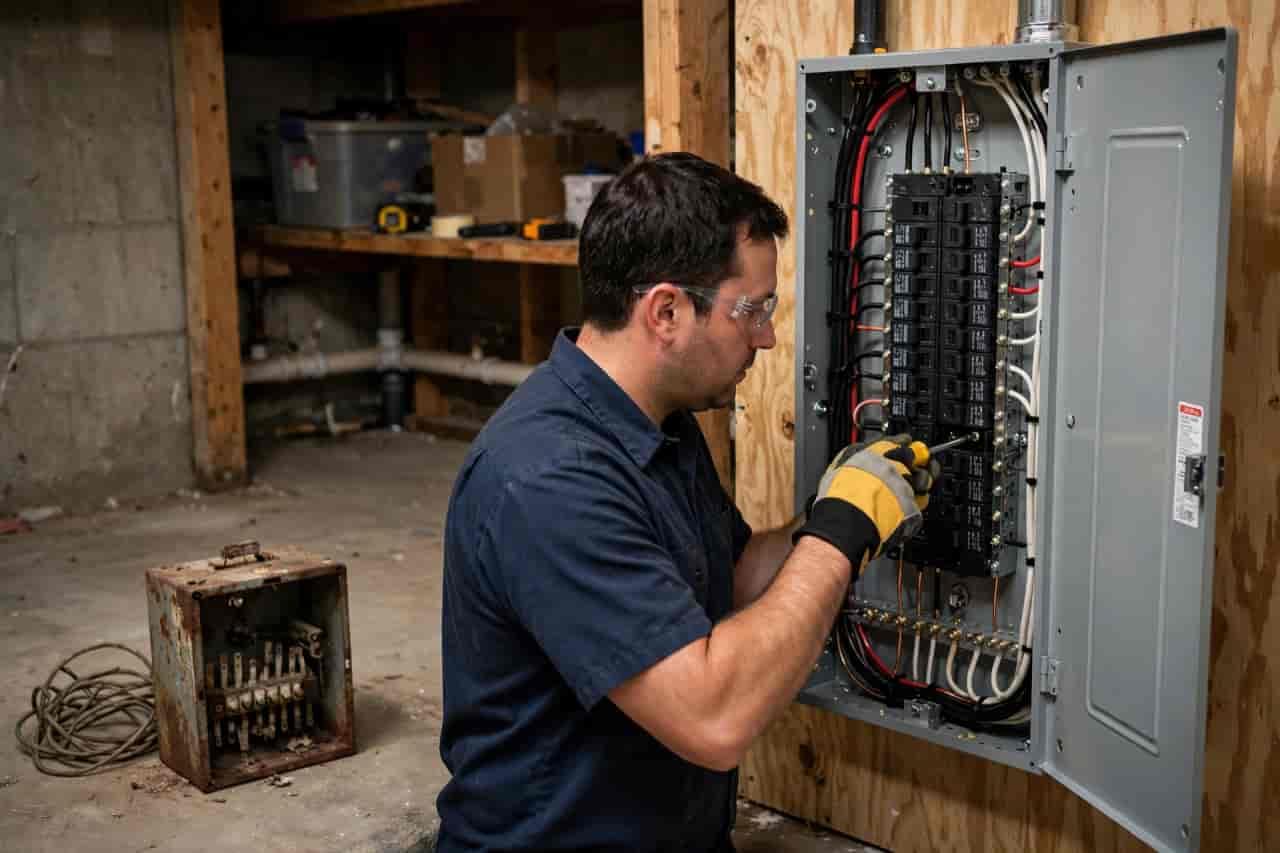
After the permit and any utility approval, the utility disconnects service, the electrician replaces the panel and often the meter socket, updates grounding and bonding to current code, labels each circuit and adds AFCI and GFCI protection where required. The building inspector signs off and the utility reconnects. For a straightforward replacement the power is usually off for most of one day.
Incentives worth checking
State programs, local utilities and federal tax rules have offered incentives for electrical work that enables heat pumps, EV charging and storage. Eligibility and amounts change often, and many programs require applying before work starts, so check current programs with your utility and the program website rather than relying on older information.
Choosing a California panel contractor
Verify the contractor’s C-10 license on the CSLB website, ask for a written scope that names the panel, service size, grounding work and who handles the utility application, and confirm the permit is pulled in the contractor’s name. For electrification projects, ask the electrician to show the load calculation so you can see whether a service upgrade is truly needed.
Licensing, permit and code requirements are set by California and local authorities and can change. The electrician confirms what applies to your project. How electrical panel upgrade works · Electricians in California