24 hour emergency service, electrical repair, panel upgrades, generator installation and EV chargers in Hialeah. Call (855) 679-2483 and get connected with an independent licensed electrician who works locally.
Hialeah began in 1921, when aviator Glenn Curtiss and cattleman James Bright platted a town on the open prairie northwest of Miami, and it incorporated in 1925. Today it is Miami-Dade’s second-largest city and one of the most heavily Cuban-American communities in the country. Florida Power & Light supplies the power. Most homes are single-story concrete-block houses from the 1950s through the 1970s, often expanded for extended families, and hurricanes such as Wilma in 2005 and Irma in 2017 shaped how residents prepare.
By calling, you agree to be connected with an independent electrician, who may call or text you back about your request at the number you call from. Calls may be recorded for quality and routing. Consent is not a condition of any purchase, and you can opt out at any time; message and data rates may apply. Privacy policy.
Serving Palm Avenue (downtown), Palm Springs Mile, Leah Arts District, Seminola, Suntan Village, West Hialeah and every other Hialeah neighborhood.
Hialeah at a glance
Electric utility
Florida Power & Light (FPL)
Permits and inspections
City of Hialeah Building Department, 501 Palm Avenue, 2nd Floor
County
Miami-Dade County
ZIP codes include
33010 · 33012 · 33013 · 33016 · 33018
Electrical services in Hialeah
What do you need help with in Hialeah, FL?
The calls Hialeah homeowners make most, followed by every service independent licensed electricians handle here.
The east side near Palm Avenue and Hialeah Park holds the oldest homes, some from the 1920s and 1930s. Most of the city is concrete-block-and-stucco ranch houses from the 1950s into the 1970s, many with flat or low-pitched roofs, followed by townhouse and condominium complexes built from the 1970s through the 1990s in West Hialeah. Garages and rear rooms converted into efficiencies are common, and their wiring was not always permitted.
Problems that come up again and again in local homes, and the service that fixes each one.
01
Efficiencies wired off the main house
Many lots carry a rear efficiency or converted garage for relatives. When its air conditioner, water heater and kitchen run off the main panel through extended circuits, an inspection shows what is overloaded and what needs a permit.
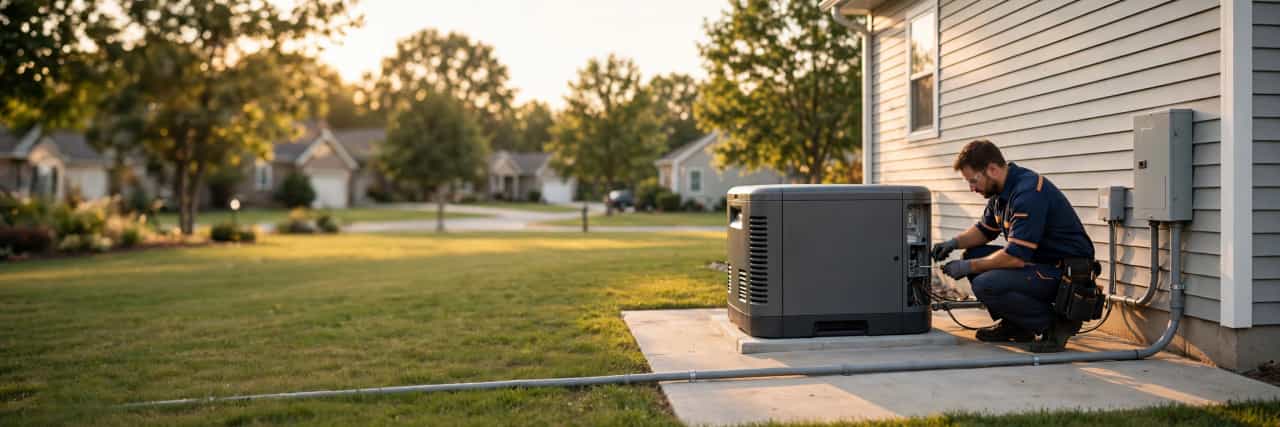
Wilma left about 98 percent of customers in urban southeast Florida dark in 2005, many for days or weeks. A permitted transfer switch or interlock lets a generator run the refrigerator, fans and a window unit without backfeeding the street.
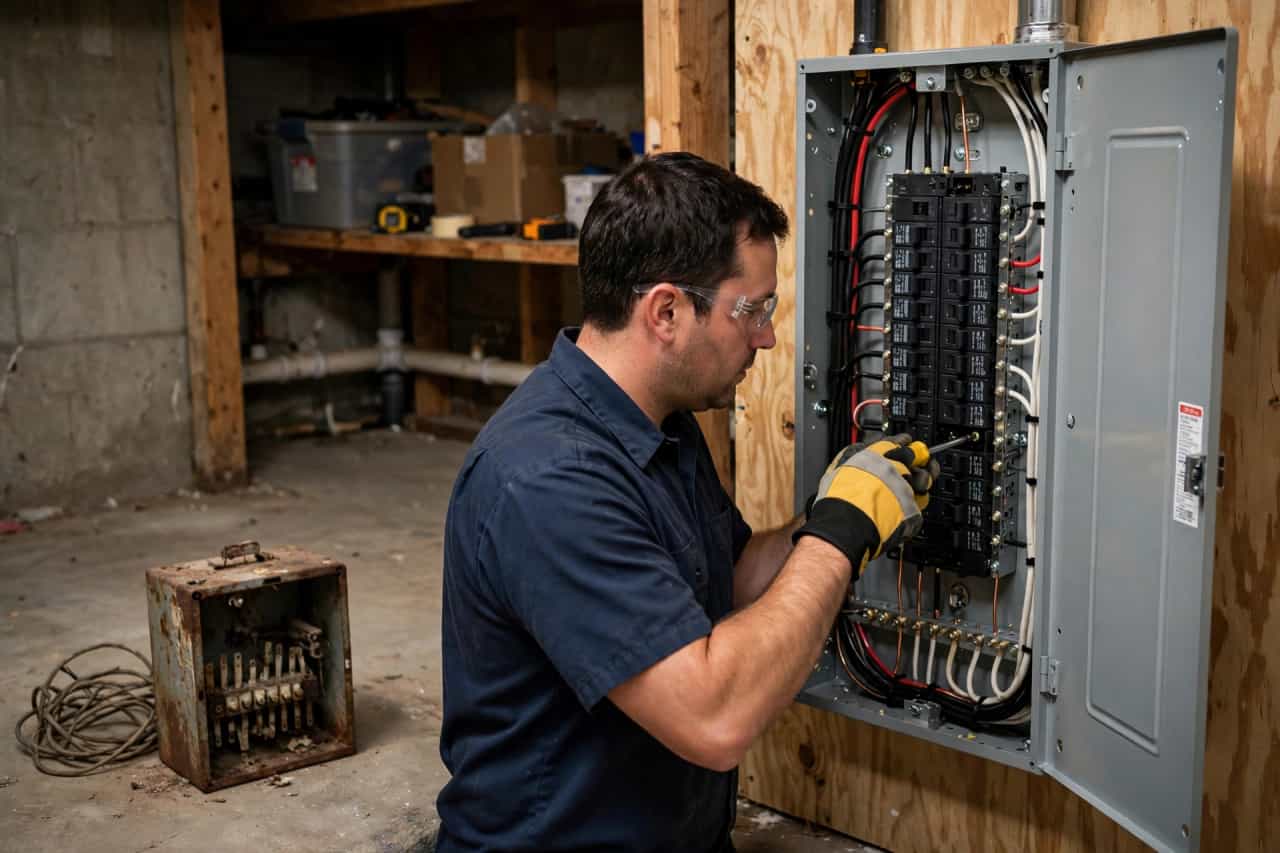
Homes from the 1950s often have only one or two outlets per room, wired behind furring strips on block walls. Window air conditioners and kitchen appliances on shared circuits trip breakers and heat receptacles.
History, housing, weather and rules that shape electrical work in Hialeah, FL.
The high prairie Curtiss and Bright platted
The name Hialeah is most often traced to Muskogee words meaning pretty prairie, and in 1921 Glenn Curtiss and James Bright drew the first plat on that open ground. Workers who came to build the town bought cheap lots and put up tent homes, wood frames with canvas roofs. The east-side grid laid out in those years still shapes the oldest blocks, where a few early houses survive among later concrete-block construction.
Incorporation in the 1925 land boom
Hialeah incorporated in 1925, at the height of South Florida’s real estate boom, with roughly 1,500 residents. Hialeah Park, whose racetrack opened that January, was already drawing crowds and later became famous for the flamingos on its infield lake. Homes built in the boom years and the 1930s that followed often had very small services, and the few that remain have usually been rewired at least once, sometimes without a permit record.
Around Hialeah Park
The streets near Hialeah Park hold some of the city’s oldest housing, including frame and masonry homes from before the Second World War. Many have been extended outward with rear rooms and carports enclosed over the decades. Each addition tends to carry its own improvised wiring. A survey of the panel, the circuits feeding additions and any splices hidden in attics is a sensible first step before buying or renovating there.
Palm Avenue and the civic core
Palm Avenue runs through downtown Hialeah past City Hall, and the Building Department sits on the second floor at 501 Palm Avenue. Electrical work in the city is permitted separately from general building work, and the permit is normally pulled by the licensed electrical contractor. Homeowners who are unsure whether past work was permitted can ask the department for the permit history of their address.
Wiring a concrete-block-and-stucco house
Concrete-block-and-stucco ranches from the 1950s through the 1970s make up much of Hialeah. Their exterior walls are block with furring strips and plaster or drywall inside, so cable runs in a shallow cavity and adding a receptacle on an outside wall can mean cutting block or using surface raceway. Interior partitions and the attic are easier paths, which is where electricians usually route new circuits.
Flat-roof concrete homes
Some Hialeah neighborhoods include mid-century concrete homes with flat or nearly flat roofs, built tough and close to the ground. Flat roofs leave little or no attic for running cable, so new circuits often travel in surface conduit or through exterior walls. Roof penetrations for rooftop equipment or solar conduit must be sealed carefully, because water entering along a pipe can reach boxes and fixtures in the ceiling below.
Efficiencies and enforcement
Hialeah has many rear efficiencies and converted garages where grandparents, grown children or tenants live. Whether one can be legalized depends on zoning, lot size and permitting, and the city cites unpermitted units and can place liens. From an electrical standpoint, an efficiency fed by an extension of the main house circuits is a fire risk. Separate, properly sized feeders and their own small panel are the safer arrangement.
Multigenerational kitchens and load
Many Hialeah households include three generations, and that shows on the electric panel. Two refrigerators, a chest freezer, extra window units, a second washer and constant cooking push older services hard, especially a 100-amp panel from the 1960s. A load calculation, not guesswork, tells whether adding circuits is enough or whether the service itself should be upgraded with FPL coordinating the meter.
Palm Springs Mile storefronts
West 49th Street, known as the Palm Springs Mile, is a long commercial strip of shops, restaurants and service businesses. Owners there call electricians for sign circuits, parking-lot lighting, refrigeration and kitchen equipment, and tenant build-outs when a space changes hands. Commercial work goes through the same Building Department, and permits, load letters and inspections need to be lined up before an opening date is set.
Leah Arts District warehouses
East Hialeah’s industrial blocks have become the Leah Arts District, where murals cover warehouse walls and old shop buildings now host galleries, food trucks, boutiques and breweries. Converting a warehouse into a taproom or event space means adding lighting, receptacles, refrigeration and sometimes three-phase equipment to services designed for storage or light manufacturing. Code-compliant emergency and exit lighting is part of most of those conversions.
West Hialeah townhouses and condos
West Hialeah, near Westland Mall and the Palmetto Expressway, is dominated by garden-style complexes, townhouses and condos built from the 1970s through the 1990s. Electrical changes there often involve an association as well as the city, especially for meter rooms, exterior lighting or a charger at an assigned parking space. Getting association approval in writing before work starts avoids disputes later.
Wilma, October 24, 2005
Hurricane Wilma crossed South Florida on October 24, 2005, and FPL reported more than 3.2 million customers without power, the largest outage in Florida history at the time. Urban southeast Florida, Miami-Dade included, was among the hardest hit, with roughly 98 percent of customers losing service, and restoration stretched over weeks. Many Hialeah families spent those days without air conditioning or refrigeration, which is why generator inlets, interlocks and dedicated generator circuits became common requests in the years after.
Irma in September 2017
Hurricane Irma reached the Florida Keys on September 10, 2017, then swept north through the state with tropical-storm and hurricane-force winds across Miami-Dade. FPL outages again ran into the millions statewide, though restoration came faster than after Wilma. Irma reminded Hialeah homeowners that a properly installed backup system, plus surge protection for the moment power returns, pays off during long hot outages.
Poles before and after hardening
After the 2004 and 2005 hurricane seasons, FPL began hardening its grid with stronger poles, more underground lines and more automated switching, and the utility has credited that work with fewer broken poles in later storms such as Irma. A sturdier grid shortens outages but does nothing for the wiring inside a home, which still has to survive surges, water intrusion and flying debris.
Summer lightning and surges
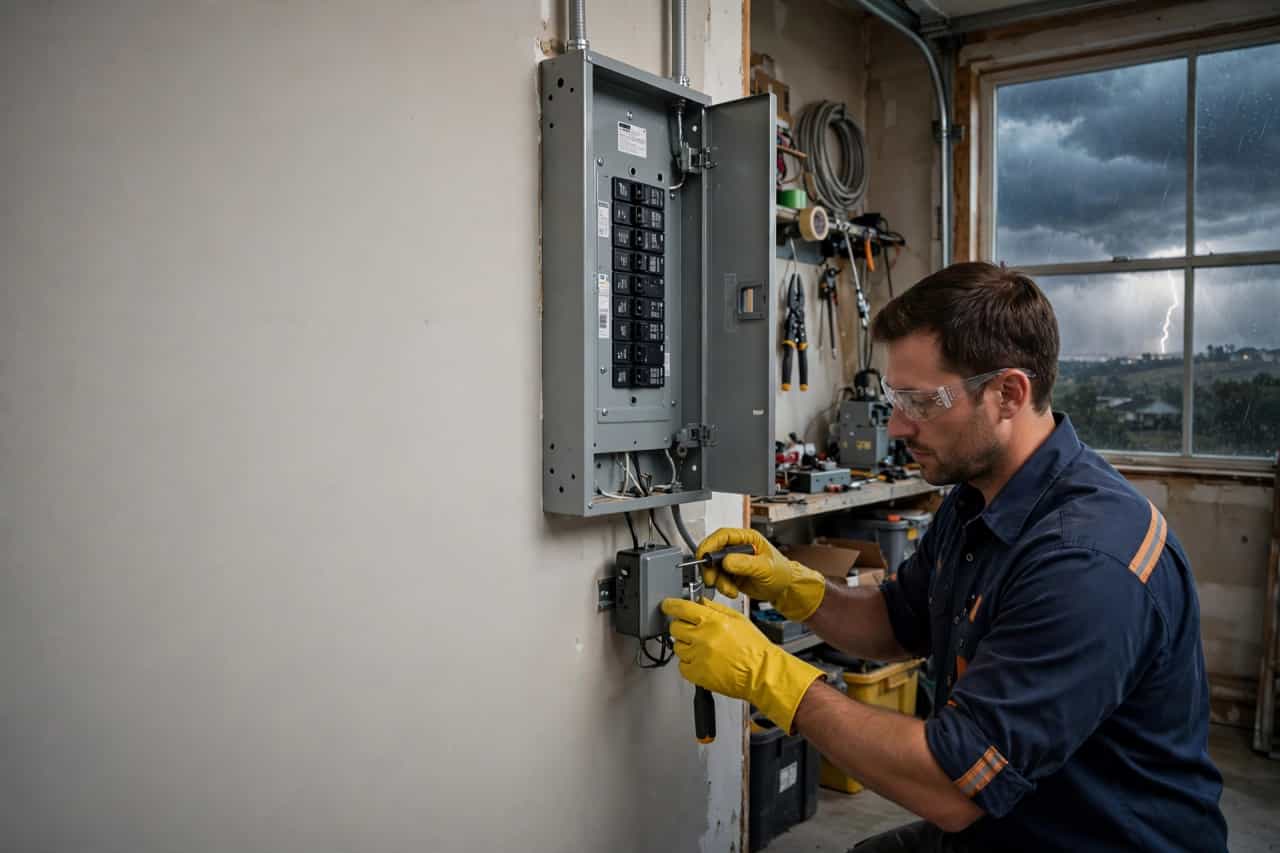
Afternoon thunderstorms build over Hialeah almost daily in the wet season, and lightning strikes nearby lines often. Surges ride in on the service and through cable and phone lines, damaging air-conditioning boards, televisions and appliance controls. A whole-home surge protective device at the panel, backed by point-of-use protection for electronics, is one of the most practical upgrades in the city.
Flat ground and flooding streets
Hialeah sits on very flat ground drained by canals, and heavy downpours can leave streets and yards standing in water. Air-conditioning condensers, pool equipment and generators set on low pads are at risk when water rises. If water has touched receptacles, a panel or a disconnect, keep away, switch off power only if the main is dry and safe to reach, and have an electrician check before re-energizing.
Building in the High-Velocity Hurricane Zone
Miami-Dade County falls within the Florida Building Code’s High-Velocity Hurricane Zone, which sets strict wind standards for anything attached to a house. Standby generators, condensers, service masts and exterior disconnects have to be anchored to resist those loads. That is one reason equipment placement and mounting details get attention at inspection, and why shortcuts on outdoor installs tend to fail there.
Window units and mini-splits
Many Hialeah homes still rely on window or through-wall air conditioners, often added one room at a time on circuits that also feed lights and receptacles. Ductless mini-splits are a popular replacement, but each outdoor unit needs a dedicated circuit and disconnect. When several are added to an older panel, a load calculation often shows that the service should be enlarged at the same time.
Checking a Florida electrical contractor
Florida’s Electrical Contractors’ Licensing Board, under the Department of Business and Professional Regulation, licenses electrical contractors statewide, and the DBPR website lets anyone look up a license. When a contractor pulls the electrical permit, the license number appears on the permit record. Confirming it before work begins protects you if the job later needs corrections or warranty repairs.
Selling an older Hialeah home
Insurers and buyers increasingly ask about panel brand and age, wiring type and any unpermitted additions on South Florida homes. In Hialeah, where many houses have grown room by room, a pre-listing electrical inspection can flag converted spaces without permits, double-tapped breakers and outdated panels before an inspector working for the buyer finds them. Fixing them in advance usually keeps a sale on schedule.
Questions
Questions from Hialeah, FL homeowners
Is there a 24 hour emergency electrician in Hialeah, FL?+
Yes. Call (855) 679-2483 any time, day or night, and you are connected with an independent licensed electrician who covers Hialeah, including Palm Avenue (downtown), Palm Springs Mile, Leah Arts District. For sparks, smoke or a hot panel, call 911 first.
Who handles electrical repair and generator installation in Hialeah?+
Licensed electrical contractors working in Miami-Dade County handle outlet and switch repair, circuit troubleshooting, panel work and standby generator installation. Permits go through City of Hialeah Building Department, 501 Palm Avenue, 2nd Floor.
Who issues electrical permits in Hialeah?+
The City of Hialeah Building Department issues them from its office at 501 Palm Avenue, second floor. Electrical work needs its own permit, normally pulled by the licensed electrical contractor doing the job. Hialeah Gardens, Miami Lakes and unincorporated Miami-Dade run their own building departments, so the property address decides where the application goes.
Who do I call if my power keeps going out in Hialeah?+
Report it to FPL if neighbors are out too, and call an electrician if only your house keeps losing power. Repeated outages at one address usually trace to a loose connection at the meter, a worn main breaker or an overloaded panel. If you see smoke, sparks or a scorched outlet, keep everyone away and call 911 before anything else.
Can I hook a generator up to my house in Hialeah?+
Yes, but only through a permitted transfer switch or a listed interlock on the panel, never through a dryer outlet or a homemade cord. Backfeeding can injure FPL line crews and damage the house wiring. Run portable generators outdoors, away from windows and doors, because carbon monoxide is a real danger after storms.
By calling, you agree to be connected with an independent electrician, who may call or text you back about your request at the number you call from. Calls may be recorded for quality and routing. Consent is not a condition of any purchase, and you can opt out at any time; message and data rates may apply. Privacy policy.
Free to call
Explain the problem in plain words
Connect with an independent licensed electrician near you
Smoke, flames or sparking? Leave the building and call 911 first.
Pronto Electrician is a free referral service. The electricians you are connected with are independent contractors, not employees or agents of Pronto Electrician. Pronto Electrician does not perform electrical work, and the electrician you choose sets the price, schedule, permits and warranty.
By calling, you agree to be connected with an independent electrician, who may call or text you back about your request at the number you call from. Calls may be recorded for quality and routing. Consent is not a condition of any purchase, and you can opt out at any time; message and data rates may apply. Privacy policy.