Jersey City packs brownstone blocks, wood-frame two-families and glass towers onto a narrow strip between the Hudson and Hackensack rivers, directly across from Lower Manhattan. PSE&G supplies the wires. Much of the waterfront sits on filled marsh, and Superstorm Sandy in 2012 and the remnants of Ida in 2021 both put water into basements where meters and panels live. Electrical work here usually means modernizing century-old buildings without tearing up plaster, or recovering after a flood.
Downtown, Hamilton Park and Van Vorst Park hold 19th-century brick and brownstone rowhouses, many split into condos. The Heights, Greenville and the West Side are dominated by early-1900s frame two- and three-family houses with a separate meter for each unit. Journal Square and the Newport waterfront add high-rises built from the 1980s onward, where unit owners deal with building management as much as with the city.
Problems that come up again and again in local homes, and the service that fixes each one.
01
Meters and panels in flood-prone basements
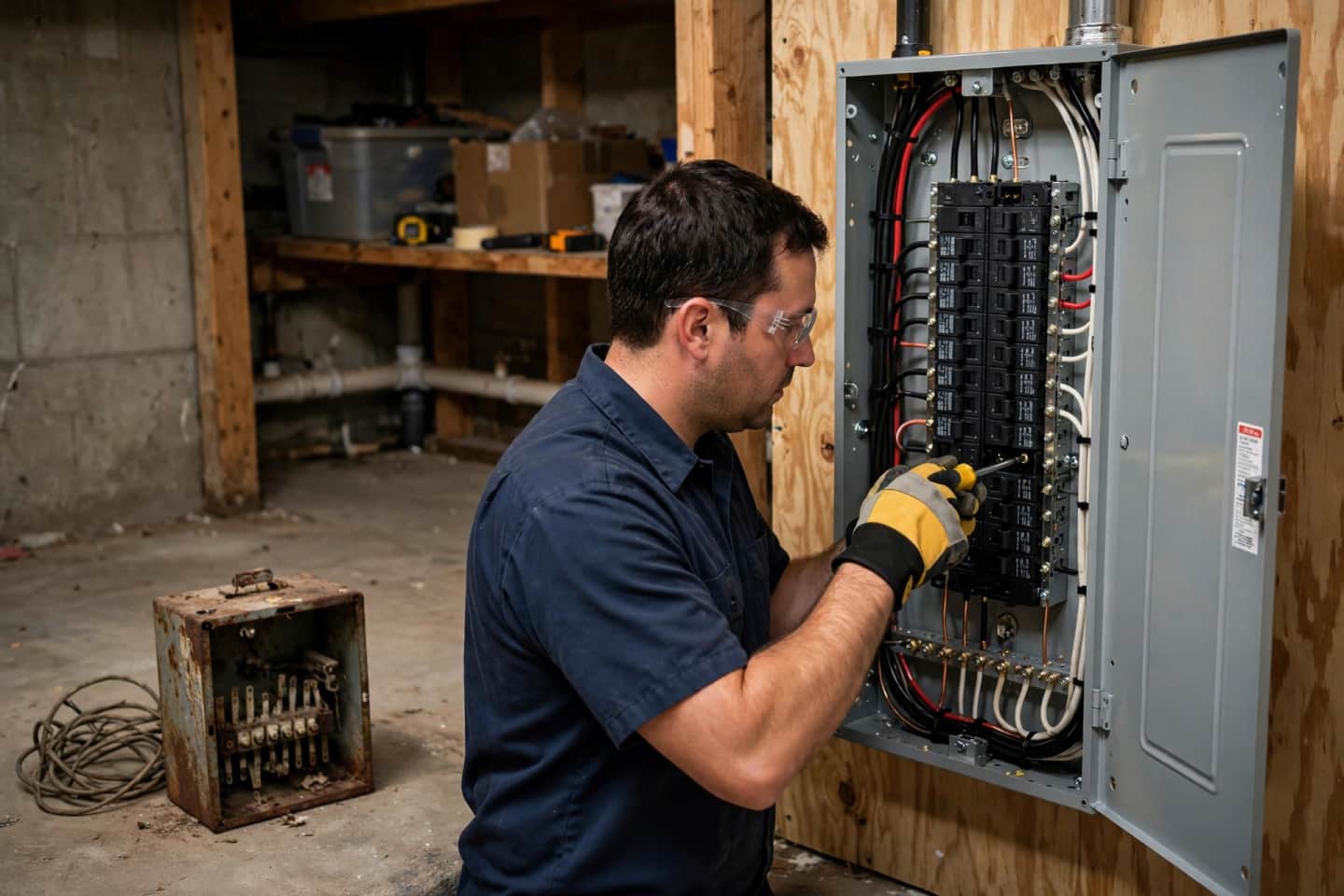
Low-lying downtown blocks took storm surge during Sandy and street flooding during Ida. Equipment that sat in water should be replaced, and some owners use a renovation to raise the panel above the basement floor.
Rowhouses in Paulus Hook and around the historic parks can still hide knob-and-tube or cloth-sheathed cable, often extended by later owners with mismatched splices.
Heights and Greenville two-families often run two or three small services side by side. Adding central air, an induction range or laundry in each unit usually means new panels and meter work coordinated with PSE&G.
History, housing, weather and rules that shape electrical work in Jersey City, NJ.
Paulus Hook rowhouses on filled marsh
Paulus Hook was once a sandy point surrounded by tidal flats, and much of today’s downtown was built on fill dumped over that marsh during the 1800s. The brick rowhouses lining Grand, Sussex and Essex streets therefore sit close to the water table. Damp cellars rust panel enclosures and corrode the neutral bars inside them, so electricians opening older downtown services often find more deterioration than the age of the equipment would suggest.
Hamilton Park and Van Vorst Park facades
Both parks are ringed by 19th-century townhouses inside designated historic districts. Exterior changes in those districts, such as relocated meters, new conduit on a front wall or added fixtures, may need review by the Jersey City Historic Preservation Commission in addition to the electrical permit. Planning the route for a new service early, often through the rear yard or basement, avoids redesigns after the electrical plan is already drawn.
Superstorm Sandy, October 29, 2012
Sandy’s surge rolled over the downtown waterfront, flooded the PATH tunnels and filled basements along the Hudson. Across its territory, PSE&G reported that roughly nine in ten customers lost power, many for more than a week. Homes where water reached the panel or meter could not simply be switched back on; they needed new equipment and an inspection before reconnection. Many downtown owners still talk about Sandy when deciding where to put a replacement panel.
PSE&G’s Energy Strong substations
After Sandy flooded substations along the Hudson, Hackensack and Passaic rivers, the first phase of PSE&G’s Energy Strong program raised, relocated or protected 26 switching stations and substations damaged by water, and a second phase continued that work. That work reduced the risk of the grid going dark from a single surge, but it does nothing for the equipment inside a house. A basement panel on a downtown block is still as exposed as it was in 2012 unless the owner moves it.
The remnants of Ida, September 1, 2021
Ida was a rain event rather than a surge. Several inches fell in a few hours, overwhelming Jersey City’s combined sewers and pushing water up through floor drains in neighborhoods far from the river. Owners who had never thought of themselves as living in a flood zone found standing water around washers, dryers and sump pumps. A dedicated, ground-fault protected sump circuit and a battery backup pump became common follow-up requests.
The Heights two- and three-families
Along the ridge north of Journal Square, the Heights is lined with early-1900s frame houses built for two or three households, many with a view toward Manhattan from Riverview Park. Each floor usually has its own meter and small panel, and the common hallway, basement lights and boiler may be fed from yet another one. Untangling which circuit belongs to which unit is often the first step before any upgrade.
Journal Square towers and the old theater district
Journal Square grew around the PATH station and the 1929 Loew’s Jersey Theatre, and since the 2010s it has added a wave of residential towers. Condo owners in those buildings rarely touch the service, but they do add circuits, lighting and chargers in garages. Those projects need both a city permit and written approval from the building’s management or association, and the latter often takes longer.
Newport and the rail-yard waterfront
Newport rose on former Erie and Pennsylvania railroad yards beginning in the late 1980s, and the waterfront between Hoboken and Exchange Place is now almost entirely high-rise. Apartments there were built with modern wiring, so service calls tend to involve tripping arc-fault breakers, failed under-cabinet lighting, or adding outlets for home offices. Riser and meter rooms belong to the building, not the unit owner.
Bergen-Lafayette gut renovations
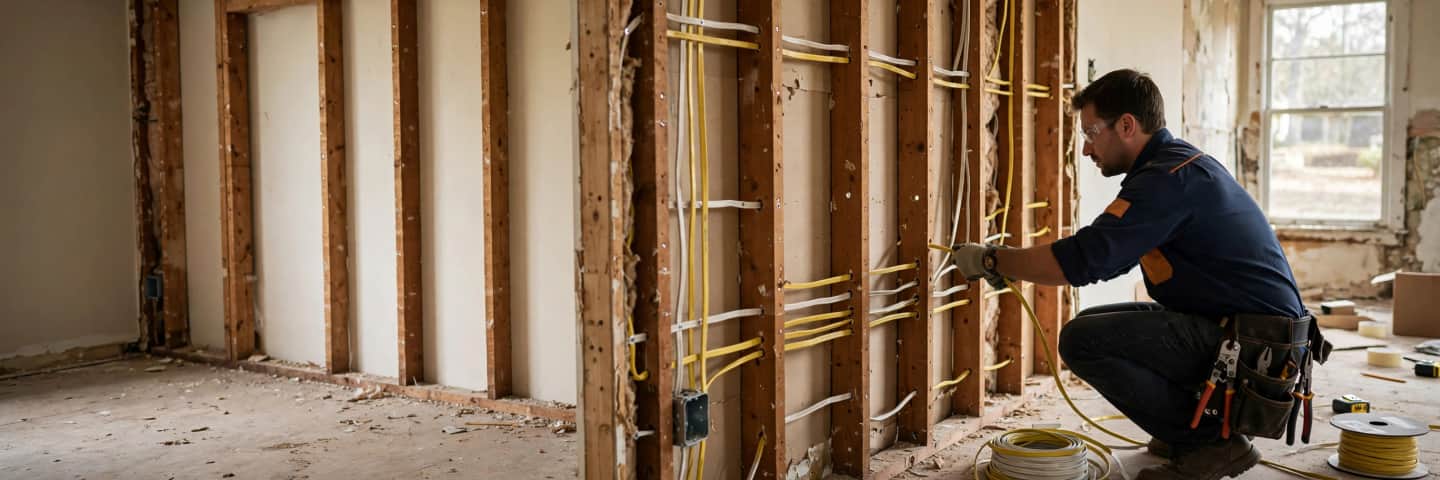
Bergen-Lafayette and the Communipaw corridor have seen a long run of rowhouse renovations as buyers moved west from downtown. When walls are opened to the studs, it is the cheapest moment to replace every circuit, add arc-fault and ground-fault protection, and size a new service for heat pumps. Inspectors review rough wiring before insulation and drywall go up, so the schedule needs room for that visit.
Greenville and the south end
Greenville, at the southern end of the city near Bayonne, is largely owner-occupied two-families and small apartment houses from the first half of the 20th century. Many still run on fuse boxes or early breaker panels with no spare spaces. Families adding window air conditioners to every bedroom frequently overload shared 15-amp circuits, and new dedicated circuits are a common, relatively modest fix.
Lincoln Park and the West Side
West of Kennedy Boulevard, the neighborhoods around Lincoln Park and New Jersey City University slope toward the Hackensack River. Housing is a mix of detached frame homes, attached brick rows and garden apartments. Student and staff rentals near the campus turn over often, which brings regular requests for fixed light fixtures, outlet repairs and the safety checks landlords need before a new lease.
Smoke and CO certificates at sale or lease
New Jersey requires a certificate showing working smoke alarms, carbon monoxide alarms and a portable fire extinguisher before a one- or two-family home is sold or re-rented. In Jersey City, the fire inspection side handles that certificate. Hardwired or interconnected alarms that have been painted over, removed or never replaced are common reasons for a failed visit, and an electrician can restore them on the original circuit.
The Powerhouse Arts District
The brick powerhouse at Washington and Bay streets, finished in the early 1900s, once generated electricity for the Hudson and Manhattan Railroad, the predecessor of PATH. The warehouses around it have since become lofts and studios. Converted industrial buildings often contain abandoned conduit, old disconnects and oversized feeders left from manufacturing days, and owners renovating a loft should have abandoned wiring identified and removed.
Liberty State Park and Communipaw fill
Liberty State Park occupies former rail yards and the 1889 Central Railroad of New Jersey terminal. The neighborhoods inland from it are built on the same kind of reclaimed ground. Underground feeds to detached garages, yard lighting and sheds in that area should use wet-location rated cable or conduit and proper burial depth, since the soil stays saturated after heavy rain.
Window units and summer heat islands
Dense blocks with little shade make July nights stay warm, and most pre-war Jersey City apartments still rely on window or through-wall air conditioners. A single bedroom circuit carrying a unit, a television and a laptop charger will trip on hot evenings. Running a dedicated outlet for each air conditioner, or planning ductless heat pumps on new circuits, is a frequent summer project.
Saint Peter’s University and McGinley Square
Saint Peter’s University sits between Journal Square and McGinley Square, surrounded by multi-family houses rented to students and young professionals. Owners of those buildings face periodic inspections and frequent tenant changes. Keeping common-area lighting, exit signs where required and hallway smoke alarms on dependable circuits matters for both safety and passing those checks.
Driveways, garages and car charging
Many Jersey City houses have no driveway, so a home charger only works where there is a rear garage, a curb cut or an assigned space in a building garage. Where parking exists, a Level 2 charger often requires a feeder run from a basement panel and sometimes a service upgrade. Condominium installs need association approval and a load review of the building’s service.
Nor’easters and Heights street trees
Winter nor’easters bring heavy wet snow and wind that bring down limbs across overhead lines on tree-lined Heights and West Side blocks. When a service drop is pulled away, PSE&G handles the line, but a bent mast, torn weatherhead or damaged meter socket on the house must be repaired by an electrician and inspected before the utility reconnects.
Working under the Uniform Construction Code
New Jersey applies one statewide Uniform Construction Code, but each municipality enforces it through its own construction official and electrical subcode inspector. In Jersey City, plans and technical forms are filed with the Division of Construction Code, and inspections are scheduled as rough and final visits. Busy periods can mean waits, so building inspection time into a renovation calendar prevents surprises.
Questions
Questions from Jersey City homeowners
Who issues electrical permits in Jersey City?+
The Jersey City Division of Construction Code, at the City Hall Annex on Martin Luther King Jr. Drive, issues electrical permits under the New Jersey Uniform Construction Code; electrical work is filed on the electrical subcode technical form. Hoboken, Bayonne, Union City and Secaucus each run their own construction offices, so the property address decides where a permit is filed.
How are electricians licensed in New Jersey?+
The New Jersey Board of Examiners of Electrical Contractors, within the Division of Consumer Affairs, licenses electrical contractors. Ask for the license number and confirm it with the state before work starts.
Who do I call during a Jersey City outage?+
Report outages and downed lines to PSE&G. If neighbors have power and only one unit or one part of your building is dark, the fault is probably on the building side and needs an electrician.
Connect with an independent licensed electrician near you
Smoke, flames or sparking? Leave the building and call 911 first.
Pronto Electrician is a free referral service. Calls are answered by independent licensed electricians in your area. Pronto Electrician does not perform electrical work, and the electrician you choose sets the price, schedule, permits and warranty.